
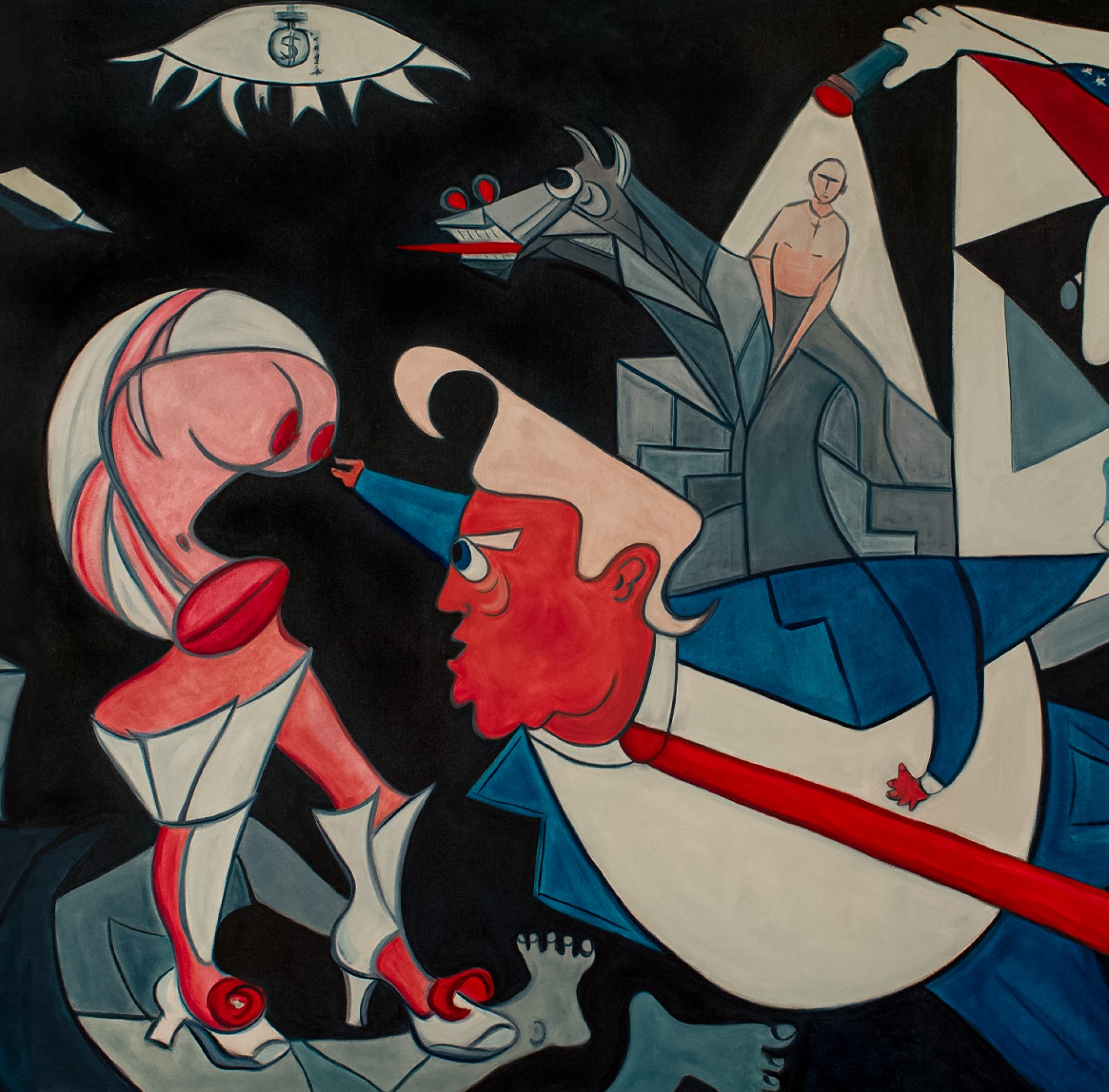
Oil on Canvas.Triptych: Central Panel 60 x 48 inches; Side Panels 30 x 48 inches


Guernica Americana draws upon formal elements of Picasso’s 1937 anti-Fascist Guernica to represent America’s contemporary tragedy: de facto capitulation to Trump’s sexist, racist, nativist, and authoritarian impulses. These broadly shared impulses led to the Trump presidency and now motivate the Big Lie, pitting regressive forces against societal progress toward equal rights. As a commentary on Picasso’s masterpiece, this work points to the perennial nature of authoritarian violence as an instrument of control, while raising more pointedly the matter of sexual titillation as a basis for political power. Guernica Americana attempts to expose the reality that Trump’s winking allusions to acts of sexual violence afford him the hyper-masculine image his base admires, the foundation of Trump’s “brand.” Trump’s presidency grew out of the worst of our country’s history and our present cultural failings, endangering all, and reviving threats that place special burdens on minorities and women. The following paragraphs describe the intent of the painting’s imagery.
At center, Trump, garishly suited and bloated with cupidity and resentment, reaches toward a nearly naked, headless figure representing women as he envisions them: all breasts, legs and genitals. Tiny hands and a freakishly long, red tie signal his masculine inadequacy and his transparent attempts to compensate. Above, a shirtless Putin on horseback dominates, as in the most widely satirized photograph of the Russian leader. Putin’s horse, alert to the scene, is abstracted with reference to the oppressively heavy concrete planes of Soviet architecture, once meant to symbolize state control. Above (at left), a light source suggests the linkage of money and power. At right, ghostly witnesses shine a light on Russian meddling and deploy to resist the unfolding tragedy. Just below, a masked woman attempts to protect her child from the terrifying political realities and the pandemic — or is it too late?
Images at the left represent America’s violence toward of those of African descent. A square-masted ship evokes the slave trade. Gender violence against African-American women is depicted by a pink male hand grasping a woman’s ankle. That image is overshadowed by the empowered central figure. She cries out and gestures, demanding justice. This maternal figure is inspired by Ms. Leslie McSpadden, the late Michael Brown’s mother. Is she wearing a halo or perhaps the Statue of Liberty’s crown of light? She raises her fist as Lady Liberty raises her torch. Below her lies a murdered Black man. His breath escapes in patterns that evoke the stained glass windows of the church where his life will be memorialized. At left, Trayvon Martin looks on, wearing a white hoodie. Above this scene, the Confederate battle flag flies and Charlottesville torches burn while an approving White Elephant appears to suck up the demonstration of hatred. The elephant is represented as white not only because of the overwhelmingly White ethnicity of the party, but because a “white elephant” signifies something laughably out-of-date that should be discarded, but is passed along as a party joke. The elephant looks on, just as the majority of Republicans have done, silent and complicit in America’s contemporary tragedy. White women (who as a group voted for Trump) do not escape accountability here. Note the pink figure in the central panel stepping on Black legs splayed beneath. The painting attempts to point to the dual reality of victimization and complicity — one to which White women must ultimately respond.
At the far right of the composition, the tragedy of Trump’s immigration policy and his denial of COVID-19 are situated amid the consequences of Americans’ historical failures, especially those rooted in bigotry and prejudice. Above, a U.S. Immigration and Customs Enforcement (I.C.E.) prison towers over a mother and child of Indigenous descent who emerge from an ear of maize. At right, two children separated from their parents look out from behind bars. 1937 is the date of the original Guernica massacre perpetrated in Spain by German Nazi forces. A gravestone represents those civilian victims, as well as the casualties of the 2020 pandemic. The Star of David on a second monument calls into question the U.S. failure to stop The Holocaust as it unfolded. Above the gravestones is the roof of Istanbul’s Blue Mosque, a reference to Ottoman architecture that suggests Trump’s hatred of Islam and Muslims as a monolithic group. A Black Lives Matter protest sign is crumpled on the ground just above Trump’s tie.
Finally, Guernica Americana is an homage to Picasso, and his ability to represent the trauma of what has been described as the first war crime of modern times. It seemed important to include Picasso’s image. At far right, below, (where an artist’s signature would typically appear,) he is represented as in his “Self Portrait Facing Death 1972,” completed at age 90. His wide-eyed expression conveys what he might feel as a witness to the current American tragedy.